Aftonbladet Is Monetizing Your Privacy
What is Aftonbladet actually selling?
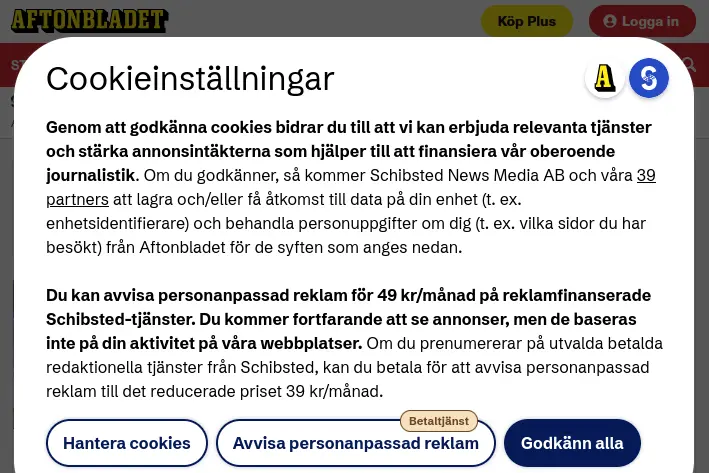
Aftonbladet now presents readers with a choice: accept that user data is collected and used for personalised advertising, or pay a monthly fee to avoid it. The FAQ published by Aftonbladet’s owner, Schibsted, says that the price is SEK 49 per month for non-subscribers and SEK 39 for subscribers. It also explicitly states that this is not a content subscription and that it provides neither an ad-free experience nor extra content. According to Schibsted’s own description, the payment is for the ability to use the services without personal data being used for personalised ads. When the company itself says that the fee does not relate to content, but to the ability to refuse tracking and data collection, then the argument that this is just another ordinary paywall falls apart.
If you have not noticed this change, it is probably because you have already, knowingly or not, consented to Aftonbladet using your data to make you a more profitable advertising target. Once you have given consent, the banner disappears.
The most revealing part of the entire setup is that Aftonbladet and Schibsted are simultaneously putting a concrete price tag on what your trackability is worth to them. SEK 49 per month is SEK 588 per year. SEK 39 per month is SEK 468 per year. In the same FAQ, Schibsted explains that the price is meant to reflect the value of the advertising revenue that is lost when personal data can no longer be used to deliver personalised advertising. But Schibsted also says that it can still show ads without that kind of profiling, only that those ads are worth significantly less. That means the fee cannot reasonably be said to reflect advertising in general. It reflects the added commercial value of being able to profile you and make advertising more profitable by turning your privacy into a revenue stream.
And not just by Aftonbladet. Your consent extends to their 39 partners. In other words, this is not simply a choice about one publisher. It is a choice about whether to let an entire advertising ecosystem profit from your data.
And this is where Aftonbladet’s model becomes even more revealing. This is not a classic “consent-or-pay” model in the usual sense, where the paying user gets an ad-free premium version. Here, Schibsted explicitly says that the paying user does not get an ad-free experience and does not get extra content. The paying user still gets the same ad-funded service, just without profiling-based targeting. That makes the setup more naked, not less: what is being sold is not access to journalism, convenience, or a premium experience, but a way out of profiling.
They are charging you to keep what should never have been up for sale in the first place.
Schibsted’s defence and why it is not enough
Schibsted’s counterargument is clear. The company says that advertising revenue is still central to the funding of journalism, that a stricter consent landscape risks leading fewer users to say yes to data collection, and that the shortfall could amount to SEK 400–500 million per year in Norway and Sweden. In SVT’s interview, Fredric Karén says that without linking refusal to payment, it would become difficult to finance journalism. But that does not answer the core question. The question is not whether media companies are allowed to charge. They are. The question is whether they are allowed to charge specifically for the right to say no to personalised advertising.
This is not about some idea that everything online should be free. Media companies absolutely have the right to charge for journalism. They can charge for subscriptions, archives, premium formats, live coverage and ad-free services. But charging for the right to say no to personalised advertising is something entirely different. That is where the line should be drawn.
Why this matters beyond Aftonbladet
And it is a line that matters far beyond Aftonbladet. If this model is normalised, others will follow. Then we end up with an internet where anyone who wants to avoid profiling and behavioural tracking has to buy their way out, site by site, service by service, month by month. Not in order to get better content. Not in order to get fewer ads. But in order to avoid having their behaviour turned into a commodity.
Why the legal basis looks shaky
The legal foundation for this model is shakier than Schibsted’s confidence suggests. PTS writes that consent to cookies must be voluntary, that it must be just as easy to say no as yes, that the user must be able to choose no in the same view, and that consent must be given specifically for each purpose. If the user neither accepts nor refuses, only necessary cookies may be stored. Marketing is not necessary.
IMY writes at the same time that consent is not freely given if the user cannot use the service without consenting to processing that is not necessary for the main service. The authority itself uses behavioural marketing as an example of something that is not necessary to deliver the core service. Schibsted will of course object that it does in fact offer a choice: pay or consent. But that is precisely where the core issue lies. How free is consent if the no-option is turned into a recurring cost? IMY’s guidance strongly suggests that such a setup is on very shaky ground. IMY also points out that simply mentioning advertising, payments or cookies in a contract does not automatically make the processing necessary for the performance of that contract.
At EU level, EDPB Opinion 08/2024 has expressed the same underlying principle, but it is important to be precise here. The opinion formally applies to “consent or pay” models used by large online platforms. It does not directly decide Aftonbladet’s case. But the EDPB also explicitly says that some of the considerations in the opinion may be useful more generally for the application of the concept of consent in such models. And the principle the EDPB sets out is clear: in most cases, it is not possible for large online platforms to obtain valid consent if the user is confronted only with a choice between consenting or paying a fee. The EDPB also stresses that personal data must not be treated as a tradeable commodity and that the right to data protection must not be turned into something people have to pay to enjoy.
That does not mean the legal position is finally settled here and now. On the contrary, SVT’s reporting shows that the issue remains contested, that Noyb is pushing criticism of the model, and that both Schibsted and Noyb are trying to influence how the issue will be resolved in Brussels. That is exactly why this is such an important turning point.
What this would mean if it becomes the norm
Normalisation happens long before final legal scrutiny is complete.
Aftonbladet is charging you because it has decided that it is entitled to profit from profiling you - and if you opt out, you should reimburse them for the loss.
And if that becomes the norm, privacy will still exist as a right on paper. In practice, it will cost you, site by site, service by service, month by month.