Celebrating AES 25 Years
On November 26, 2001, the National Institute of Standards Technology (NIST) published the US federal standard FIPS 197. Advanced Encryption Standard (AES), specifying the AES block cipher. Twenty-five years later AES has become the most analyzed, used, and trusted block cipher. Something we think is worth commemorating.
In this blog post we'll take a look at the history of AES, what AES does, and look at where and how AES is being used. We also raise the question if AES can be trusted to still be secure. And finally, the future for AES. Here we go!
Table of contents
- What lead to AES
- The AES competition
- The Rijndael algorithm and AES
- The AES algorithm
- AES in hardware and systems
- Where AES is used
- Security
- The legacy of AES
- The legacy of the AES process
- The future for AES
- Final thoughts
What lead to AES
In 1977, the National Bureau of Standards (NBS) in the United States published FIPS 46, which introduced the Data Encryption Standard (DES), a block cipher with 56 bit effective key, a 64 bit wide block and 16 iterations (rounds) to process a block.
By the 1990s, DES shortcomings was creating problems. Its key was too short to provide the security needed. This was demonstrated in 1998 when the Electronic Frontier Foundation (EFF) demonstrated a brute-force attack in just 56 hours with their DES Cracker machine. The block size of DES imited the size of messages that could be protected with one key. The block size also lead to low performance.
In September 1997, NIST therefore announced the plan to hold an international competition to standardize a new block cipher. As a stopgap, in 1999 NIST amended the DES standard with TDEA, also known as Triple DES. Basically three DES operations in sequence. Still with a 64-bit block, but with a 112 bit key. And with 48 rounds, making TDEA much, much slower than the already too slow DES.
The AES competition
In 1997, NIST announced the plan for a competition. The NIST publication from 1997-09-12 formally announcing the start of the AES competition stated:
A process to develop a Federal Information Processing Standard (FIPS) for Advanced Encryption Standard (AES) specifying an Advanced Encryption Algorithm (AEA) has been initiated by the National Institute of Standards and Technology (NIST).
This notice requests submission of candidate algorithms for consideration for inclusion in the AES and specifies how to submit a nomination package. The requirements for candidate algorithm submission packages and minimum acceptability requirements that must be satisfied in order to be deemed a ‘‘complete and proper’’ submission are presented. the evaluation criteria which will be used to appraise the candidate algorithms are also described.
It is intended that the AES will specify an unclassified, publicly disclosed encryption algorithm available royalty-free worldwide that is capable of protecting sensitive government information well into the next century.
The purpose of this notice is to solicit candidate algorithms from the public, academic/research communities, manufacturers, voluntary standards organizations, and Federal, state, and local government organizations. Following the close of the submission period, NIST intends to make all submissions publicly available for review and comment.
With the AES competition, NIST introduced how cryptographic standards are developed. Before AES, ciphers were something by and large provided with limited motivation how they worked and why they were secure.
In fact, before DES was published in 1977, the specification was modified based on recommendations by the NSA. No motivation was given at the time. In 1994, one of the authors of DES explained that the changes introduced resistance to differential cryptanalysis, a technique published by Eli Biham and Adi Shamir in 1993.
The AES competition in numbers
- NIST announced acceptance of candidates in September 1997
- NIST received 21 candidates
- 15 algorithms from 12 different countries were accepted as candidates
- Narrowed to 5 finalists:
- Rijndael (Belgium)
- Serpent (UK/Norway/Israel)
- Twofish (USA)
- RC6 (USA)
- MARS (USA)
- Selection process took four years (1997–2001)
The AES competition was an open process where anybody could submit, analyze, attack the candidates and publish the results. NIST also participated in conferences and organized open conferences, discussions about the candidates in terms of security, performance and implementation aspects.
As Vincent Rijmen, one of the authors of the candidate Rijndael remembers it:
"I think that NIST has been very professional in the organisation of the AES competition. They had a good framework to encourage participation of designers and evaluators. They raised publicity. They cooperated with major cryptographic conferences to attract people’s interest. What was also very typical was the amount of effort that the participating teams and companies put into this competition. For 3 years, we did nothing else than trying to break the other submissions, to analyse claims on our own algorithm and trying to refute them."
One consequence of the AES competition was a rapid improvement in the field of cryptographic design and analysis. In October 2000, NIST published the Report on the Development of the Advanced Encryption Standard (AES) describing the analysis of the finalists.
In the end, all finalists were deemed to provide the required security. But a cipher does not just have to be secure: it also needs to be usable in a wide variety of systems. Therefore, NIST also looked at other factors when selecting the winner. Factors such as:
- Performance in SW and HW
- Flexibility and agility
- Ease of implementation in SW and HW
- Memory, CPU and HW resource requirements
Later in October 2000, NIST selected Rijndael as the winner of the AES competition. Given the multi-year effort to perform cryptanalysis and attacks, development of new methods and an open process was instrumental in establishing trust in AES from day one.
The Rijndael algorithm and AES
Rijndael was created by the researchers Vincent Rijmen and Joan Daemen


Vincent Rijmen (left) is today a researcher at the Computer Security and Industrial Cryptography (COSIC), Leuven, Belgium.
Joan Daemen (right) is full professor of symmetric cryptography at Radboud University Nijmegen, The Netherlands.
Rijndael was quite a departure from the existing block ciphers at the time. As Vincent Rijmen explains the origin:
"Rijndael is based on the PhD research of Joan Daemen and myself. While doing our PhDs, we did not know that a few years later there would be an AES competition.
So we did this research from the comfortable “ivory tower” of academic research: trying to make a new blockcipher that was mathematically elegant, with provable security properties and good performance on the range of computing platforms that were popular at that time.
We wanted to show that we could do better than DES, Blowfish, etc., but we were also simply interested in solving the mathematical puzzle. (And we needed to obtain publishable results in order to get our PhDs ;-)"
The elegance and simplicity made Rijndael easier to analyze, easier to implement correctly and easier to optimize.
During the NIST competition, Rijndael was consistently the fastest or one of the fastest of the candidates over a range of use cases.
Rijndael also use very simple operations - XOR, byte substitution, byte shifts - making Rijndael very easy and cheap to implement. Other candidates used multipliers and wide adders that may not be available or resource heavy, even slow in embedded systems.
Rijndael is divided into separate but similar parts: encryption, decryption and round key generation. This makes it possible to share functionality. It also makes it possible to remove parts. For use cases where only encryption is needed, the whole decryption function can be removed, reducing resources such as code size and hardware logic.
Rijndael does not need preprocessing or complex initialization as some of the other finalist, for example Twofish. No preprocessing makes it fast and easy to switch keys and modes - what NIST calls key agility.
In fact, as NIST stated in their report, it was not the security aspects that made NIST select Rijndael as the winner: NIST selected Rijndael for its adaptability, versatility, and efficient implementation across a wide variety of use cases and environments.
The AES algorithm
The version of Rijndael selected by NIST has a 128 bit block and supports 128, 192 and 256 bit keys, with 10, 12 and 14 rounds respectively. This allowed AES to support different security levels with one implementation. The larger block size compared to DES allowed it to support much larger messages protected with one key. The larger block size combined with rounds also made AES faster that DES.
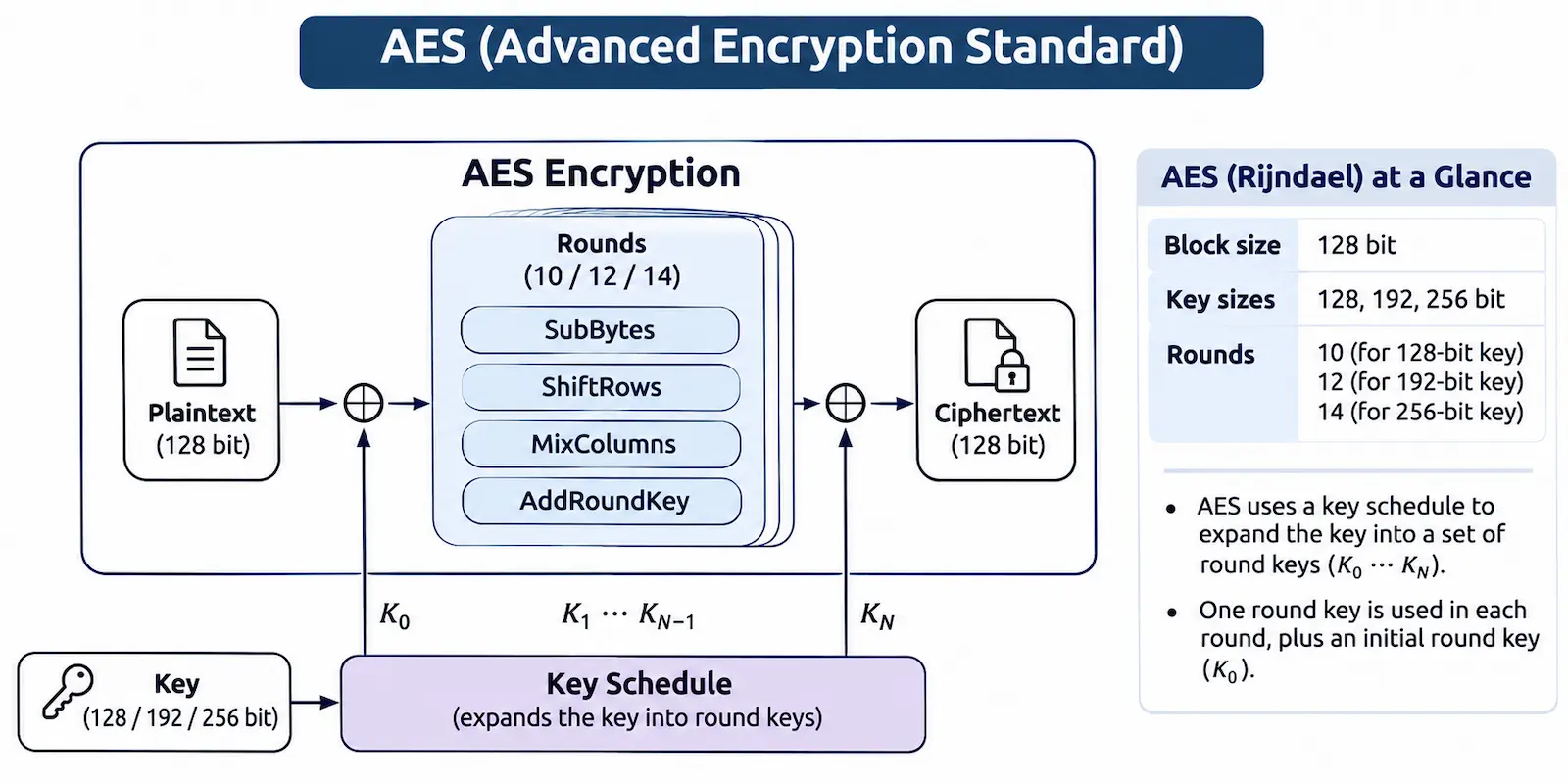
AES has a key schedule that expands the given key into a set of round keys, one key for each round. The round keys kan be calculated ahead of time and stored in a memory. But the round keys can also be calculated in sync with the rounds. In a fully pipelined implementation this means one can perform AES operations with a new key for each block.
We at Assured have developed an implementation of AES that can be used to protect the main memory for a process, no matter if there are 10, 100 or 10000 processes. An implementation that can deliver data rates of 100 GBps.
At the other end of the spectrum, as mentioned before, major parts of the logic for encryption, decryption and key schedule can be shared, reused on a byte level. For example the encipher S-box. The S-box can also be implemented in logic. All these options allows for very compact implementations.
We at Assured have developed and delivered AES implementations that are used in extremely resource constrained sensors and systems.
In summary, AES is simply a very flexible and useful cipher for many use cases and systems. As an engineer, AES is fun and rewarding to work with.
AES in hardware and systems
The established trust given by the open, multi-year AES competition as well as implementations developed during the competition allowed for rapid adoption.
Helion Technology even started offering an AES core for integration into FPGAs and ASICs in the summer of 2001, before FIPS 197 had been published.
Soon after FIPS 197 was published, microcontroller (MCU) manufacturers began integrating hardware implementations of AES into their MCUs, enabling secure communication in embedded systems with minimal processing overhead, code size, and RAM requirements.
But (at least according to us) the really big development regarding AES implementations happened in 2010 when Intel introduced the Advanced Encryption Standard (AES) New Instructions (AES-NI) for X86-64. The AES-NI instructions allowed acceleration of AES with a small set of instructions:
AESENC: One AES encryption round. Performs the SubBytes, ShiftRows, MixColumns, AddRoundKey functionsAESENCLAST: The final encryption round, with no MixColumnsAESDEC: One AES decryption roundAESDECLAST: The final decryption roundAESIMC: Inverse MixColumns function. Used to derive round keys needed during decryptionAESKEYGENASSIST: Support instruction to derive reound keys
The AES-NI instructions work on 128-bit XMM registers, which were introduced as part of the first generation of the Streaming SIMD Extensions that came in 1999. The AES-NI instructions allowed AES SW implementations to reach performance levels previously only found in dedicated (and expensive) hardware. ARM introduced a similar set of instructions in the ARM Crypto Extensions in 2011.
These instruction extensions shows how important AES had become. Support for cryptography at instruction level in commercial CPUs was until then quite novel, and possibly surprising. As Daemen responded to one question:
Q: What has surprised you the most these years related to AES?
A: "That Intel and other chip manufacturers added dedicated AES instructions to their CPUs"
Where AES is used
It is hard to single out a particular use case because AES is all around us, securing billions of devices and services. If you have used the internet today, you have probably used AES.
But AES is also used to secure:
- Wi-Fi (WPA2/WPA3)
- Bluetooth
- Disk encryption (BitLocker, FileVault, LUKS)
- Cloud storage
- Banking and payments
AES can also be found in everyday devices and infrastructure:
- Car key fobs and vehicle immobilizers
- Entry systems, smart doors and locks
- Smart meters and power grids
- Toothbrushes
- Pacemakers
AES is even used in cat feeders.
Since AES scales from resource-constrained systems to the largest servers and communication systems, implementations are available for a wide range of platforms:
- 8-bit microcontrollers
- 32-bit and 64-bit CPUs
- Dedicated hardware
- Embedded devices
AES is implemented in the Linux kernel, Android, macOS, iOS, Windows, and countless other systems and operating systems. Where AES-NI or similar processor instructions are available, they can be used to accelerate AES operations. AES is also supported by virtually all cryptographic libraries, making it readily available to application developers.
AES is legion.
Security
Analytical attacks
So, after 25 years, is AES still secure? Can we trust it?
Yes, we believe so.
It is hard to estimate the number of academic papers on the cryptanalysis of AES published over the past 25 years. Searches across various academic and conference databases suggest that the number is in the thousands. If papers covering performance, optimization, and practical applications are included, the number is likely several times higher. Research on AES is still ongoing. So far in 2026, 31 articles covering cryptanalysis, attacks, and other aspects of AES have been submitted to the Cryptology ePrint Archive.
Despite this extensive research, none of these papers have demonstrated a practical break or substantially undermined the security of AES. Arguably, the two most significant cryptanalytic results since AES was published are:
-
Related-Key Cryptanalysis of the Full AES-192 and AES-256 (PDF) by Biryukov and Khovratovich in 2009. The presented attack against AES-256 has a computational complexity of 299.5 but requires four specifically related keys.
-
Biclique Cryptanalysis of the Full AES (PDF) by Bogdanov, Khovratovich, and Rechberger in 2011. This paper presents key recovery attacks against full-round AES, with computational complexities of 2126.1, 2189.7, and 2254.4 for AES-128, AES-192, and AES-256, respectively.
Neither of these attacks makes AES insecure in any practical sense. And no significant improvements have been presented since then.
AES is still approved for protection of SECRET and TOP SECRET classified information in countries such as the United States, the United Kingdom, Canada, Germany, Australia and France. Countries like Japan, Mexico and Argentina use AES for government secure communication. The same is true for organisations like NATO and EU.
If a country relying on AES had discovered a major weakness in the cipher, we would likely have seen signs of a migration away from AES or restrictions on the classification levels of information it is approved to protect. Given the extensive global interest in AES cryptanalysis, we also consider it unlikely that only one entity would have discovered a major weakness over these 25 years.
AES is very likely the most analyzed symmetric cipher, both in public and closed environments. The enormous research volume and the continued trust globally is a major reason we belive AES can still be trusted today. Probably more than any other cipher.
Side-channel and fault attacks
One area where practical attacks against AES have been shown is on implementations, more specifically related to side-channel leakage and fault injection attacks.
Side-channel leakage refers to the unintended disclosure of information about the internal state of a system during operation. Typical side-channel attacks exploit variations in execution time or power consumption that depend on the values of bits in the data or cryptographic keys being processed.
For AES, cache-timing attacks that exploited lookup-table memory access patterns in software implementations allowed practical attacks on deployed systems. A good example is the paper Cache-timing attacks on AES (pdf) by Daniel J. Bernstein in 2005. One important thing to note about this attack is that it requires the attacker to know the plaintext being encrypted. In a real-world setting this is not very realistic.
Side-channel attacks led to the development of constant-time cryptography, meaning the execution time is always the same and not affected by the data or the key. The adoption of AES-NI and similar CPU instructions made side-channel attacks much harder since they provide constant-time execution. In hardware implementations constant-time execution is easier to accomplish. Instead, difference in power consumptions due to data values (for example in the S-boxes) also lead to leakage of key material. This led to the development of masking techniques and other ways to perform constant-power cryptography.
Fault injection attacks are physical attacks where for example glitches on the power supply or the clock signal is used to force the target system to end up in unexpected or faulty states. Fault injection attacks have allowed attackers to recover keys from smartcards and embedded devices since 2003. A good example of a fault attack is presented in the article Practical Setup Time Violation Attacks on AES (pdf) by Selmane and Guilley in 2008.
Fault injection attacks are local attacks on single devices. Protecting against them is hard. It requires handling many incorrect states, redundancy, masking, and mechanisms for detection, but also spike filters, capacitors and other analog electronics. Fault injection attacks are still relevant today in hardware security.
The legacy of AES
The success of AES as a cipher has lead it to become an inspiration for other cryptographic primitives. As Vincent Rijmen stated it:
"It is very pleasing to see that many new encryption algorithms adopt the “wide trail” methodology that was invented by Joan and further developed by both of us to create Rijndael."
AES has also become a building block for new cryptographic primitives, which incorporate the AES S-box, the AES round function, or even the entire cipher. Authenticated encryption algorithms such as AEGIS and hash functions such as ECHO are built around the AES round function. Members of the SNOW family of stream ciphers, used in mobile communication systems, incorporate either parts of or the entire AES round function.
One reason for using the AES round function is the prevalence of dedicated instructions such as AES-NI in CPUs. This means that primitives that reuse the AES round function can be accelerated too.
But it is not only because of performance: as we've seen, AES is probably the most analyzed and trusted cipher. This means that reusing the round function makes it easier to analyze and trust that part of a new cipher.
The legacy of the AES process
The openness of the AES selection process, and the resulting trust and widespread adoption, inspired other organizations to adopt similar competitions and processes for developing cryptographic primitives. Some examples are:
- eSTREAM competition to find stream ciphers,
- Password Hashing Competition (PHC) to find new password hashing algorithms, and
- CAESAR competition to find new algorithms and functions for authenticated encryption (AE).
NIST itself has continued to use and refine the process to develop the SHA-3 hash function, standardize lightweight cryptography (LWC), and run the Post-Quantum Cryptography (PQC) competition to identify asymmetric (public-key) algorithms designed to withstand attacks by a cryptographically relevant quantum computer (CRQC, a rather hard acronym to pronounce).
In the case of PQC, we can see a similar pattern of adoption to that of AES. When NIST published its first PQC standards in August 2024 (ML-KEM, ML-DSA, and SLH-DSA), standards organizations such as the IETF and ETSI moved quickly to incorporate these algorithms into their standards, while vendors and open-source projects began developing and offering implementations and integrations. In fact, much like with AES, several organizations and projects had already begun this work as soon as NIST announced which algorithms had been selected for standardization.
Today, these PQC algorithms can be found in applications, cryptographic libraries, operating systems, and cloud environments such as Azure, AWS, and GCP. Post-quantum cryptography is also already being used in TLS 1.3.
Running open and transparent competitions with international participation has simply become the method for developing cryptographic functions that can be trusted. The well-known cryptographer Daniel J. Bernstein (djb) published in 2024 the paper Cryptographic competitions (pdf) that surveys cryptographic competitions and how they lead to secure and good algorithms (or not).
The future for AES
Attacks from Quantum Computers
AES, being a symmetric cipher, is not vulnerable to Shor's algorithm, but its effective security against brute-force attacks is theoretically reduced by Grover's algorithm. Grover's algorithm provides a quadratic speedup for exhaustive key searches using a quantum computer, theoretically reducing the security of AES-256 to a level comparable to that of AES-128 against classical brute-force attacks.
Post-quantum cryptography (PQC) migration strategies in several countries continue to recommend or mandate AES-256 as a symmetric block cipher suitable for use even in the presence of cryptographically relevant quantum computers (CRQCs). Unlike traditional public-key algorithms, AES is therefore expected to remain relevant well into the post-quantum era.
AES and AI
It is hard to write anything in 2026 without mentioning AI. So far, we have not seen any significant new cryptanalytic results or attacks generated by AI models. However, we expect AI to be increasingly used in attempts to attack AES and other ciphers. Given its widespread adoption, AES is arguably the juiciest target among symmetric cryptographic primitives for such attacks.
Next generation of AES
After 25 years, some of the design parameters of AES have begun to impose limitations on certain applications. The 128-bit block size limits the amount of data that can be securely protected under a single key and can impose constraints on throughput. To address these limitations, NIST is pursuing a standardization effort known as Wide-AES, extending FIPS 197 with a variant featuring a 256-bit block size and a 256-bit key. This variant will also be able to leverage existing AES-NI instructions for hardware acceleration.
Modern symmetric ciphers
Although AES is flexible, versatile, and fast, it is still a block cipher. To be useful in practice, a block cipher generally needs to be combined with a block cipher mode of operation that provides message-level security and, depending on the mode, authentication and other security properties. These modes require additional resources and introduce complexity. They can also make it difficult to reuse a single AES instance for different cryptographic functions. In some cases, AES needs to be combined with another cryptographic primitive. One example is the GHASH function, which is used to provide authentication in the widely adopted authenticated encryption mode Galois/Counter Mode (GCM).
Since AES was introduced, the field of cryptography has evolved beyond traditional block cipher constructions to new types of cryptographic primitives. As Joan Daemen wrote:
"A better alternative [to block ciphers] is sponge-function and deck-cipher based cryptography."
Sponges are a class of cryptographic functions that accept (absorb) input data to update their internal state and then generate (squeeze) a sequence of output data. Joan Daemen is one of the inventors of sponge functions and one of the creators of the sponge-based hash function Keccak. Keccak won NIST's cryptographic hash function competition and became the SHA-3 standard in 2015 (FIPS 202).
An example of a standardized sponge-based algorithm family is Ascon. Ascon won NIST's Lightweight Cryptography competition and was standardized in 2025 (SP 800-232). Although Ascon may not offer the same flexibility as AES in terms of performance and resource requirements across all platforms, its ability to provide authenticated encryption, hashing, and extendable-output functionality using a common underlying permutation makes it a versatile and potentially more resource-efficient alternative to AES.
Final thoughts
AES has been securing the world's communications for 25 years. It is all around us. We use AES every day, and it makes our lives more secure. We don't know what the world will be communicating about in the future, but those communications will probably be protected by AES or something built upon it.
At Assured, we celebrate everything AES has done over the past 25 years, and all that it will continue to do, with the Assured AES cake!
Happy birthday, AES!